
Customized Excellence
Advanced Medical Extrusions












aliphatic
Organic chemical compounds in which the carbon atoms are linked in open chains, including paraffins, olefins and acetylenes. Aliphatic compounds have lower unsaturation indices than aromatic compounds.
amorphous polymer
A polymer having no crystallinity; for example, polysulfone. See Thermoplastics.
aromatic
Organic chemical compounds in which the carbon atoms are linked in a ring structure; examples are benzene, toluene and napthene. Aromatic compounds have enhanced chemical stability and have higher unsaturation indices than aliphatic compounds.
ASTM
American Society for Testing and Materials
bulk density
The weight of a unit of a material in powdered or granular form, including voids (air) inherent in the material.
bump tubing
A tube (also called taper tube or draw down) that has different diameters at each end; the diameter may also vary along the tube’s length. Generally, the smaller diameter end is inserted into the body and the larger diameter attaches to the medical device.
co-extrusion
The process of combining or layering materials so that the medical tube obtains characteristics from each. For example, one material might help a very small tube retain the flexibility to reach further into the vasculature while the other material supplies the strength and kink resistance needed to push it in. Co-extrusion may change a tube’s appearance, chemical characteristics or mechanical attributes, like lubricity.
coefficient of friction
A measure of the difficulty with which the surface of one material will slide over the surface of another material.
copolymer
Two monomers polymerized together to form a polymer.
crosshead
A device for changing the extrudate flow.
crystallinity
Ordered repeated structures (crystals) encountered in polymers below a certain temperature. Most polymers are semi-crystalline, containing both crystalline and amorphous regions. See Thermoplastics.
degradation
A change in the properties—tensile strength, color, shape, etc.—of a material under the influence of one or more environmental factors, such as heat, light or chemicals.
density
Density affects most end-product physical properties like stiffness, impact strength and optical properties. See Specific Gravity.
durometer
A test that measures hardness using the depth of an indentation in a material created by a given force on a standardized pressure foot. This depth depends on the hardness of the material, its visoelastic properties, the shape of the pressure foot and the duration of the test. Depending on the testing standard used, there may be as many as 12 scales. In general, the A scale is for softer plastics and the D scale is for harder ones. A higher value indicates a harder material. See Hardness.
elasticity
The plastic’s ability to return to its original size and shape after being deformed. Elasticity is the opposite of pasticity, in which plastic holds the shape to which it is deformed.
elongation at break
The maximum elongation a plastic can undergo. See Tensile Elongation.
engineering resins
Resins for high-performance applications, such as polycarbonate (PC).
extruder
Equipment for melting, pressurizing and homogenizing plastics by means of a rotating screw. Different configurations are possible; the most simple one is a single screw extruder mainly used for conversion processes like profile extrusion.
glass transition temperature
The lowest temperature at which a polymer can be considered softened and possibly flowable. The temperature at which amorphous polymers undergo a second order phase transition from a rubbery, viscous amorphous solid to a brittle glassy amorphous solid.
guidewire
Guidewires are inserted in a patient to the spot where a catheter or other tube must go. The medical tube is then inserted over the guidewire. Coatings increase lubricity, reduce the risk of infection or add other desired characteristics.
hardness
Resistance of a surface to deformation. The different hardness measures for characterizing polymers include Shore hardness (two scales, A for softer and D for harder materials). See Durometer.
HDT
See Heat Distortion Temperature.
heat distortion temperature
The initial softening point of a polymer. It relates closely to the glass transition temperature of the polymer. Mechanical strength deteriorates above the heat distortion temperature (HDT).
heat resistance
The ultimate heat resistance is the temperature above which irreversible degradation occurs to the material. Up to this temperature, if the material is cooled, it will revert to an equal or slightly stronger level. Above this temperature, strength is lost even after cooling.
implant
A device that is placed into a surgically or naturally formed cavity of the human body and is intended to remain implanted continuously for a period of 30 days or more. The FDA may use its discretion to determine whether devices placed in the body for shorter periods of time are implants.
lubricity
Having a slippery or smooth quality. Good lubricity goes with a low coefficient of friction.
melting point
The temperature at which the structure of a crystalline polymer is destroyed to yield a liquid. It is not scientifically correct to talk about the melting point of an amorphous polymer because it has no crystalline structure. In extrusion practice, however, the glass transition temperature plus 122°F (50°C) is often used to define an equivalent melting point for amorphous polymers.
miniaturization
The drive to miniaturize reflects the desire for minimally invasive procedures and for appropriately sized pediatric products. Tubes with micro-miniature dimensions have the potential to considerably reduce trauma and risk, particularly for pediatric patients.
multi-lumen
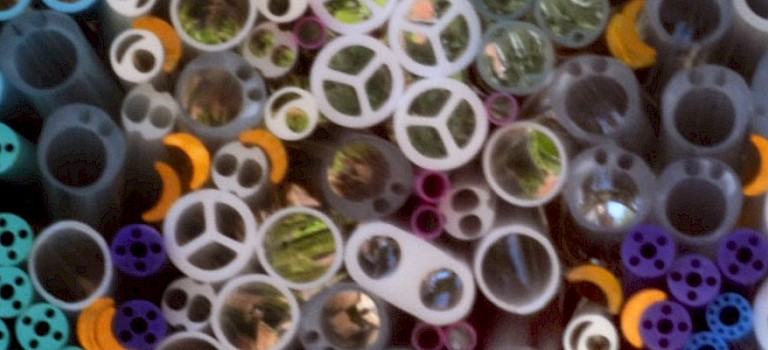
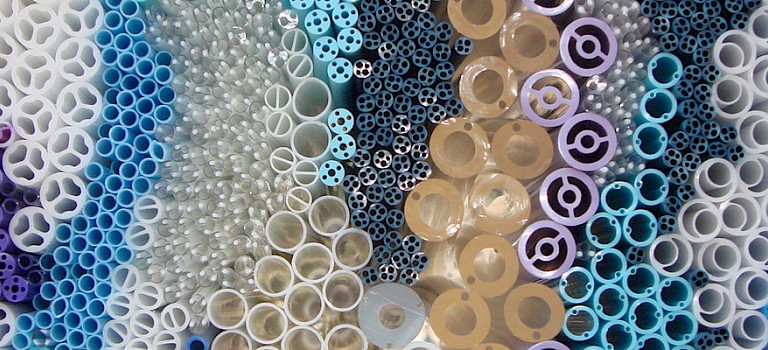
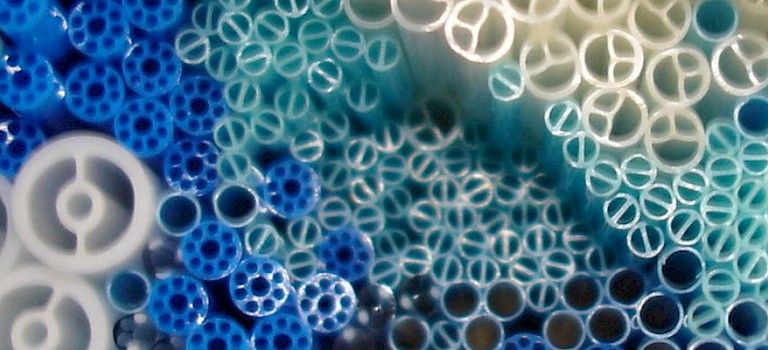
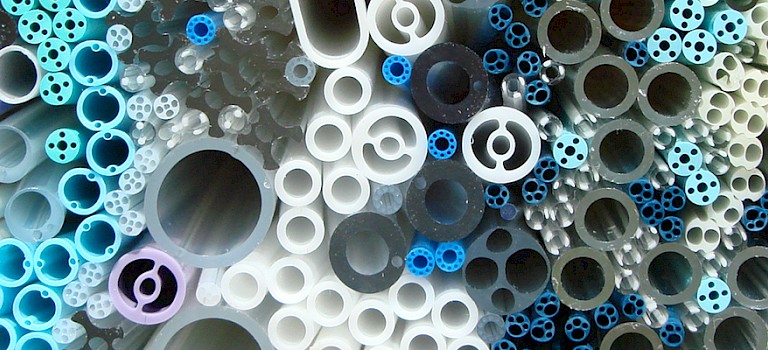
Tubing with multiple holes (lumens) through which different tasks can be accomplished; for example, delivery and withdrawal of fluids, steering a catheter with a wire, grasping tissue for a biopsy or allowing doctors to monitor progress using a fiber optic line during surgical procedures.
operating temperature
It’s generally acceptable to use 9 to 18°F (-12 to -7°C) below the heat distortion temperature (HDT) as the maximum short-term operating temperature.
plasticity
The plastic’s ability to hold the shape to which it is deformed. Plasticity is the opposite of elasticity, in which plastic returns to its original size and shape after being deformed.
polymer
A large molecule (macromolecule) composed of repeating structural units connected by covalent chemical bonds. Well-known examples of polymers include plastics, DNA and proteins.
profile extrusions
Tubes that are not circular in shape and/or have lumens that are not circular. A D-shaped tube, for example, might be necessary to meet specifications such as flexibility or strength or to connect to a medical device.
properties
The physical and mechanical properties of a polyurethane, nylon or engineering resin depend on its chemistry, structure, chain length and bonds between chains. They can be altered by combining the material mechanically and chemically with other materials, creating a copolymer that shares some of the properties of both materials.
radiopaque
Materials that are visible in x-rays, such as barium sulfate, bismuth subcarbonate, bismuth trioxide and tungsten. See Stripes.
shore hardness
See Hardness.
specific gravity
The ratio of the density of a given substance to the density of water when both are at the same temperature, making it a dimensionless quantity. Substances with a specific gravity greater than 0.036 lb/in.3 (1 g/cc) are denser than water and will sink in it. Specific gravity is a special case of, or in some usages synonymous with, relative density. See Density.
stripes
A clear tube with co-extruded stripes to help identify the tube or orient it to the body, while still allowing the contents of the tube to be seen. An irrigation device, for example, might have two long tubes, one to deliver liquid and one to flush it. When each tube is striped with a different color, they are easy to identify and separate no matter how long they are or how deep they go. Yet the striping also leaves a clear “window” in the tube, allowing medical personnel to track the tube’s contents. Stripes can also carry radiopaque materials (barium sulfate, bismuth subcarbonate, bismuth trioxide and tungsten) that are visible in x-rays. As an example, the radiopaque stripe on a urology stent indicates whether the curled end is in the correct position before the guidewire is extracted. Radiopaque stripes must be concentric to keep them visible to the x-rays from every angle in the body.
tensile elongation
The amount that length increases in response to a tensile load, expressed as a percent of the original length. Elongation at break is the maximum elongation the plastic can undergo.
tensile strength
The amount of stress a material will endure before failing. In general, tensile strength increases with polymer chain length. Tensile properties are the most important indication of the strength and stiffness of the material.
thermoplastics
Polymers that can be melted by heating and solidified by cooling, and may be re-melted repeatedly. Thermoplastics are elastic and flexible above each resin’s specific glass transition temperature. Depending on the temperature, most thermoplastics have a crystalline region (giving them strength and rigidity) and an amorphous region (giving them elasticity). Amorphous thermoplastics do not crystallize and are most often used in applications where clarity is important.
vicat softening point
The temperature at which a flat-ended needle of 1 mm2 circular cross-section will penetrate a thermoplastic specimen to the depth of 1 mm under a specified load using a selected uniform rate of temperature rise. It’s the softening point for materials (such as polyethylene) that have no definite melting point. Also known as Vicat hardness.
viscosity
The resistance to flow of a fluid, defined as the ratio of shear stress to shear rate. The viscosity of a polymer decreases as the shear rate increases.
water immersion
The percent increase in weight of a specimen (dried for 24 hours) before and after immersion in 23°C water for various times. This property affects dimensional stability and some mechanical properties.